Portable Beauty: How Containers Shape the Way We Apply Cosmetics
Portable beauty depends on more than a small package. Learn how closures, mirrors and applicators shape a routine, and choose a format that suits your day.
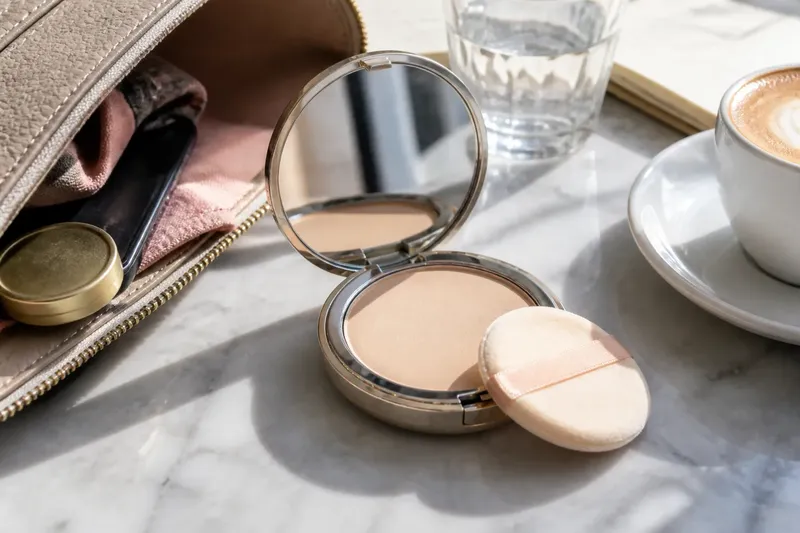
A balm tin knocks against a phone in a coat pocket, while a compact opens on a café table. Portable beauty is not simply a smaller dressing-table ritual: the container affects what can be carried, how a product is used and whether applying it becomes visible to others.
Portable beauty depends on the whole object
Historical cosmetic containers varied across periods and communities, and surviving objects do not by themselves tell us who carried them or where they were used. Rather than treating every small vessel as an early pocket compact, it is more useful to ask what its shape could accommodate: product, an applicator, or both.
A container for powder or paste needs to keep its contents together, while an applicator must be accessible when needed. The lid, opening and relationship between vessel and tool all shape the experience. Portability depends on the user, clothing, journey and occasion—not just the object’s size.
Think of a lunch tin: it has to suit both its contents and the way someone carries it. A narrow cosmetic tube may protect a small amount of product, while a broad case may make access easier but take up more room.
A compact brings mirror and application together
A compact can combine pressed powder, a mirror and a closable case. That arrangement lets someone open the case, inspect their face and apply product without setting out a separate mirror. The lid does more than decorate the package; it makes storage and viewing part of one brief routine.
Opening a compact in public may read as a discreet touch-up, a private pause or a polished gesture, depending on the setting and the object. A bright case can attract attention; a plain one may blend into a bag. Portability is therefore about social visibility as well as physical size.
Imagine someone starting a train journey with loose face powder in a fabric pouch and a separate mirror. If the pouch opens and powder escapes, they might switch to a closed compact with a built-in mirror. The expected observable result is a tidier touch-up with fewer separate objects to handle, though the compact may take up more space.
How does portable beauty fit different routines?
Why do some cosmetics travel more easily than others?
Pressed or solid formats can be easier to contain than loose powders or runny products, but the closure and applicator matter too. A sturdy case may still be awkward if it needs a separate brush or product collects around its rim.
What makes a compact different from a palette?
A compact usually centres on a closable case for one product or a small set, often with a mirror. A palette arranges several shades or functions, offering more choice but usually requiring more room and a different application routine.
Does portable beauty always mean smaller packaging?
No. A mirror, applicator or protective sleeve can make the full package larger than the product alone. Portability means that the entire object suits a way of carrying and using it, not that every component has been made as small as possible.
What should I check before carrying a cosmetic?
Check that the lid closes, the formula suits its container and any applicator can be stored cleanly. For a refillable case, confirm that the replacement pan or cartridge is compatible rather than relying on a similar appearance.
Check the closure, access and refill before choosing
- Observe whether the lid stays shut when the case is moved; if it does, consider carrying it as intended, but if it opens easily, choose a more secure closure or keep it in a protective pouch.
- Observe whether loose product escapes around the rim; if residue stays contained, the format may suit your bag, but if it spills, choose a more tightly closed case or a solid format.
- Observe whether the applicator fits inside the package; if it does, you can carry the set together, but if it needs a separate tool, choose a format with an integrated applicator or plan separate storage.
- Observe whether the mirror gives a usable view when the case is open; if it does, it can replace a separate mirror, but if the angle is awkward, choose a simpler case and carry a mirror separately.
- Observe whether the latch opens comfortably without popping free; if it releases smoothly, access is straightforward, but if it catches or springs open, choose a different closure.
- Observe whether the refill matches the case and can be removed as intended; if both fit, refill use is an option, but if compatibility is uncertain, check the product details or choose a non-refillable format.
Say you have a hypothetical workday with a powder compact, a small shoulder bag and no room for a separate mirror. You inspect the compact: its latch stays closed when handled, its mirror opens to a useful angle, and its applicator fits inside, but a replacement pan does not match the case. The resulting choice is to carry the compact for that routine while treating it as a fixed case, or to choose a compatible refillable design if continued refilling matters more than keeping this particular compact.
Closures and refills create different trade-offs
Twist-up sticks, squeeze tubes, screw-top pots and click-shut compacts protect and dispense products in different ways. A stick keeps fingers away from the bulk product but leaves its surface exposed during use; a pot can hold a flexible formula but requires a finger or tool to reach it.
A refillable compact links the case to a compatible replacement pan or cartridge, so matching parts and storing the empty unit become part of the routine. A fixed case may be familiar and sturdy, while a lightweight disposable package may be simpler to replace. Neither format alone settles questions about material impact: construction, replacement habits and local disposal options all matter.
Where possible, handle a case before choosing it. Notice whether the hinge stays open at a usable angle, whether the latch releases without popping open, and whether the mirror can be seen comfortably. These practical observations say more about a routine than a decorative claim of being travel-friendly.
Carrying cosmetics can change their social meaning
A portable product moves application beyond a fixed dressing table. A washroom, workplace or seat beside a window can become a temporary place to use it. That freedom is not identical for everyone: clothing pockets, bags, shared spaces and expectations about public grooming affect what feels comfortable to carry and use.
An object may signal taste, status or care, but its appearance cannot explain its owner’s routine. A metal case kept for refills and a disposable tube have different forms and uses; neither alone tells the full story. Looking at how a package works keeps cultural interpretation grounded in what the object actually does.
Choose portable beauty for the place it will be used
Portable beauty has no single ideal format. The right choice depends on what needs protection, which tools must be nearby and where application will happen. A compact may combine useful functions yet feel cumbersome; a plain stick may be easy to reach but lack a mirror or applicator.
Before choosing portable beauty, consider the product, closure, applicator, mirror and the place the package will live between uses. A well-matched format is not necessarily the smallest one; it is the one whose trade-offs suit the routine you actually have.